
|
||
|

|
||
|
The Believer’s Guide to Legal Issues is a book written by PA State Representative Stephen Bloom. Each chapter highlights everyday situations and how a believer verses a non-believe might handle the situation In reading this book, it is great to know that there are still lawyers in today’s age honoring God and leading people towards Christian values rather than trying to make a dollar. Irene highly recommends reading this book.
A Christian mediation and reconciliation process can be pursued simply and informally by seeking the assistance of a trust brother or sister in Christ to help disputing parties talk through and resolve their differences, or it can be pursed formally by involving the leadership of the Church or a professionally trained mediator. To read more, see The Believer’s Guide to Legal Issues
Are you aware of Common Core? Do you know what our children today, leaders of tomorrow, are being taught? What have YOU done to stop this nonsense of “common core?”
Republican Women clubs on a national, state, and local level are concerned about the future of our children and country. Why not visit a meeting and see how you can be involved and make a difference?
National Federation of Republican Women’s Common Core Resolution – http://www.nfrw.org/documents/resolutions/20111002_national_standards.pdf
SUN Area Council of Republican Women’s Common Core Resolution – http://sunacrw.com/2013/08/20/sunacrw-formally-opposes-common-core-state-standards/


Sanctity of Human Life Sunday 2014 commemorates 41 years since the January 22, 1973 Roe v. Wade U.S. Supreme Court decision that legalized abortion in our country. Since then, more than 55 million* abortions have taken place in the U.S. The human lives lost to abSanctity of Human Life Sunday 2014 commemorates 41 years since the January 22, 1973 Roe v. Wade U.S. Supreme Court decision that legalized abortion in our country. Since then, more than 55 million* abortions have taken place in the U.S. The human lives lost to abortion exceed the number of people currently living in our Great Lakes Region!**ortion exceed the number of people currently living in our Great Lakes Region!** (read more)

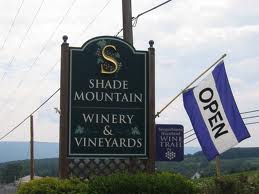 PA Federation of Republican Women will be holding a Fall Conference on October 19, 2013. They thank the Shade Mountain Winery for allowing them to hold their event at such a beautiful location.
Conference registration starts at 8:30 am with the conference starting at 9:00 am. Join women and men around the state for a fun filled educational day. Information about the conference can be found at http://ncpfrwconf.wordpress.com/
The conference will conclude at 2:00 pm. Following the conference, Shade Mountain Winery has agreed to host a tour of the winery.
The cost for the entire day, including a light breakfast, lunch, speakers, fun, and networking is $35.00. Make your reservation today! http://ncpfrwconf.wordpress.com/registration-form/

District Judge Rob Wyda, who served Bethel Park and Upper St. Clair, died Monday evening.
According to the Allegheny County medical examiner’s office, the cause of death was heart disease.
Judge Wyda, 54, was a lawyer before his election to the district court position in Bethel Park in 1999. He took office in January 2000.
The office was later merged with the Upper St. Clair district court office to become one of the largest magisterial districts in the county.
Before becoming a district judge, he spent seven years as an assistant district attorney and three years as an assistant court administrator supervising the county’s district justices.
He ran a brief campaign for Superior Court this spring, but withdrew before the primary.
He was also a member of the Naval reserves and a Navy judge advocate who took assignments in Afghanistan, Iraq and Guantanamo Bay between 2003 and 2008.
Published August 6, 2013 10:05 am
By Brad Bumsted and Salena Zito
Published: Monday, July 29, 2013, 11:56 a.m.
Updated 2 minutes ago
HARRISBURG — Former Gov. William Scranton Jr., who left his mark on state government with sweeping education reform that remains in place, died Sunday at age 96.
A family spokesman said Scranton, governor from 1963-67, died of a cerebral hemorrhage at a retirement community in Montecito, Calif. He had a home in Waverly, just outside the city of Scranton.
Scranton was United Nations Ambassador in 1976-77. He chaired the commission that investigated the 1970 shooting of unarmed college students by the Ohio National Guard at Kent State University.
“Governor Scranton was a world-class leader in government. He will be remembered as a man of humility, honesty, dignity and integrity,” said Gov. Tom Corbett. “He was a member of ‘The Greatest Generation,’ putting his own dreams on hold to serve as a pilot during World War II, returning home to lead by example as he served his fellow Pennsylvanians.”
Scranton was a member of President Gerald Ford’s transition team and a director of a long line of corporations, from IBM and the H.J. Heinz Co. to the New York Times. During World War II he was a transport pilot for the Army Air Forces.
As governor he separated higher and basic education and oversaw the creation of community colleges, said J. Wesley Leckrone, a political science professor at Widener University.
“He prioritized education, economic development and job creation,” said U.S. Sen. Bob Casey, a Scranton Democrat. “When he left office after four years as governor, Pennsylvania’s unemployment rate was one of the lowest ever.”
Former reporter John Taylor, who became a spokesman under three governors who served later, said the Scranton administration’s establishment of the community college system helped in “making higher education more affordable to kids from low- and middle-income families.”
Pennsylvania expanded state parks during Scranton’s tenure and performed major rehabilitation of bridges and highways. The state Department of Community Affairs, now part of another agency, was created to focus on problems of local governments.
“It was four years of an awful lot of changes and progress for Pennsylvania,” said his son, Bill Scranton, a former lieutenant governor. His father’s interactions with people of all walks of life helped spur his success.
“He just liked people,” the younger Scranton said. “He honored them and cared about them. He just had a touch. People liked him. He genuinely respected people of all backgrounds. He never looked down on people.”
Scranton’s death “signals the end of the moderate wing of the Republican Party,” Leckrone said. “That wing of the party no longer seems to be in order nationally or in Pennsylvania.”
Scranton briefly ran for president in 1964, when the late Sen. Barry Goldwater of Arizona won the Republican nomination.
Former U.S. Rep. Bud Shuster of Altoona called his longtime friend and fellow Republican a “fine man” who had a way of “lighting a room up wherever he went.”
Scranton was willing to compromise to get things done, Shuster said.
“That does not mean he compromised on principles; you never do that,” said Shuster, 81. “But he was able to get compromise on issues to move legislation. (He) was willing to sit down and talk with all sides — something missing today.”
Scranton served one term in Congress, from 1961-63. He became known as a “Kennedy Republican” who supported some of former President John F. Kennedy’s programs on civil rights and the Peace Corps, said G. Terry Madonna, a political science professor at Franklin & Marshall College.
He won the Scranton congressional seat in a Democratic district — helped by having the same name as the city named for his ancestors who opened mines and railroads in the mid-1800s.
Party leaders liked him for governor as a Yale University graduate and a “Mr. Clean, moderate Republican with a progressive agenda,” said Madonna, who noted that Democratic voters for the first time in 1960 outnumbered Republicans. “In the 1960s Pennsylvania became a two-party state.”
In 1962, as a popular congressman, Scranton defeated Democrat Richardson Dillworth, who touted credentials as a reformer and Philadelphia mayor.
Scranton became Pennsylvania’s 38th governor, serving one term — the maximum at the time. Following a change in the state constitution that allowed successive terms, every governor elected since has served two terms.
“He was someone who had an enormous amount of class,” said Jim Roddey, the Allegheny County Republican Committee chairman.”He looked like a governor, sort of that patrician look. He was a real statesman.”
In an interview with the Tribune-Review in 2011, Scranton talked about the death of former first lady Betty Ford. He met when both were congressmen and helped with Ford’s transition to the presidency in August 1974, following Richard Nixon’s resignation at the height of the Watergate scandal.
“It was such a very difficult period in our country. The wounds were still very raw,” Scranton told the Trib. Ford had been vice president for less than a year, replacing Spiro Agnew, who resigned because of bribery and tax evasion charges.
“People forget how bad it was. They believe their time is the most divisive,” Scranton said in 2011.
U.S. Sen. Pat Toomey, R-Allentown, said Scranton’s life was “dedicated to the service of our great commonwealth and our country.”
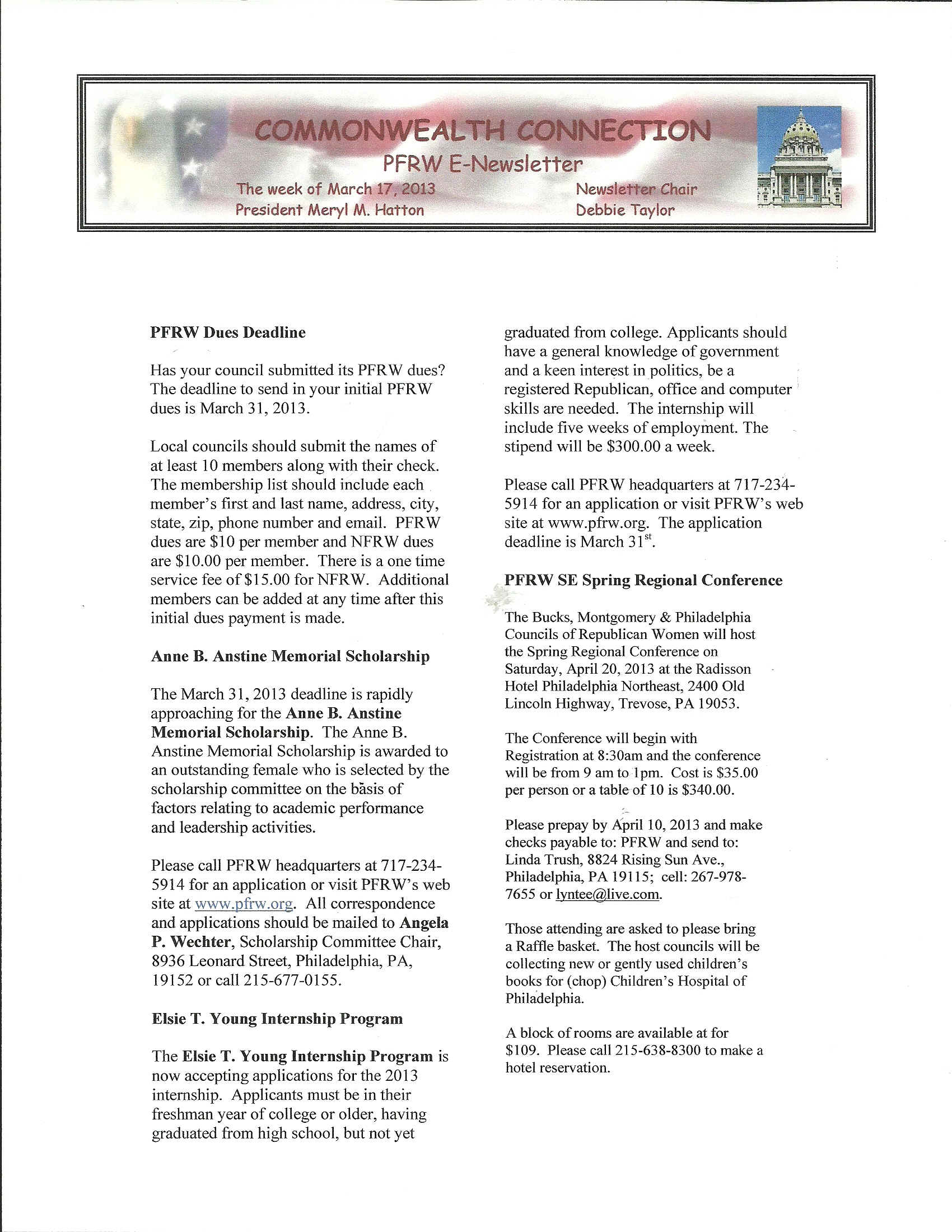
We apologize for posting this late. Although the June PFRW board meeting is over, you can still register for NFRW Convention and learn more about common core.
Why I Was Wrong
By DICK MORRIS
Published on DickMorris.com on November 7, 2012
I’ve got egg on my face. I predicted a Romney landslide and, instead, we ended up with an Obama squeaker.
The key reason for my bum prediction is that I mistakenly believed that the 2008 surge in black, Latino, and young voter turnout would recede in 2012 to “normal” levels. Didn’t happen. These high levels of minority and young voter participation are here to stay. And, with them, a permanent reshaping of our nation’s politics.
In 2012, 13% of the vote was cast by blacks. In 04, it was 11%. This year, 10% was Latino. In ’04 it was 8%. This time, 19% was cast by voters under 30 years of age. In ’04 it was 17%. Taken together, these results swelled the ranks of Obama’s three-tiered base by five to six points, accounting fully for his victory.
I derided the media polls for their assumption of what did, in fact happen: That blacks, Latinos, and young people would show up in the same numbers as they had in 2008. I was wrong. They did.
But the more proximate cause of my error was that I did not take full account of the impact of hurricane Sandy and of Governor Chris Christie’s bipartisan march through New Jersey arm in arm with President Obama. Not to mention Christe’s fawning promotion of Obama’s presidential leadership.
It made all the difference.
A key element of Romney’s appeal, particularly after the first debate, was his ability to govern with Democrats in Massachusetts. Obama’s one-party strident approach, so much the opposite of what he pledged in his first national speech in 2004, had turned voters off. But by working seamlessly with an acerbic Republican Governor like Christie, Obama was able to blunt Romney’s advantage in this crucial area.
Sandy, in retrospect, stopped Romney’s post-debate momentum. She was, indeed, the October Surprise. She also stopped the swelling concern over the murders in Benghazi and let Obama get away with his cover-up in which he pretended that a terrorist attack was, in fact, just a spontaneous demonstration gone awry.
Obama is the first president in modern times to win re-election by a smaller margin than that by which he was elected in the first place. McKinley, Woodrow Wilson, FDR, Eisenhower, Nixon, Reagan, and Clinton all increased their re-election vote share significantly. Obama’s dropped from a 7 point margin over McCain to a 1 point margin over Romney.
That he could get re-elected despite his dismal record is a tribute to his brilliant campaign staff and the shifting demographics of America. This is not your father’s United States and the Republican tilt toward white middle aged and older voters is ghettoizing the party so that even bad economic times are not enough to sway the election.
By the time you finish with the various demographic groups the Democrats win, you almost have a majority in their corner. Count them: Blacks cast 13% of the vote and Obama won them 12-1. Latinos cast 10% and Obama carried them by 7-3. Under 30 voters cast 19% of the vote and Obama swept them by 12-7. Single white women cast 18% of the total vote and Obama won them by 12-6. There is some overlap among these groups, of course, but without allowing for any, Obama won 43-17 before the first married white woman or man over 30 cast their vote. (Lets guess that if we eliminate duplication, the Obama margin would be 35-13) Having conceded these votes, Romney would have had to win over two-thirds of the rest of the vote to win. He almost did. But not quite.
If Romney couldn’t manage this trick against Obama in the current economy, no Republican could.
But that doesn’t mean we just give up. Obama barely won this election and we still have a Republican House of Representatives. We still have the ability – and more important, the responsibility – to fight to keep this great country as we know it and love it.
We must stop Obama’s socialist agenda. That’s our job for the next four years. We cannot allow Obama to magnify his narrow victory into a mandate for larger government, bigger spending, and less freedom.
This is not a call for gridlock. If Obama moves to the center and proposes moderate measures, we should support them. But that’s unlikely.
So we have our work cut out for us.

 Rock Star GOP - Grassroots Activism Awareness